

The current discourse about AI agents centers mostly on personal agency. Your agent writes code, prepares you for calls, remembers context, and gives you increased leverage over your work. My own agents already help me with significant parts of my job, and we are just starting to understand how they will affect our lives.
But personal agency is just the beginning. The question I am more interested in is what happens when agents become coordination technology: shared tooling that helps groups of humans achieve their goals. Can agents enable new interfaces for collaboration, helping people turn shared context into shared action? If agents can expand what we can do together, they could become new infrastructure for communities, cities, movements, polities, and even democracies.
I spend the majority of my time thinking about how people come together and do things they could not do alone. After a few years of organizing popup villages, founder residencies, and other social forms, I am increasingly convinced that personal flourishing depends more on collective agency than our culture tends to admit. A good group makes you more capable. It gives you courage, context, accountability, taste, meaning, and a reason to try harder than you would have tried alone. Improving how groups function could be a major part of helping individuals flourish in the future.
Beyond individual wellbeing, this matters for human progress. Many important advances through history came downstream of new coordination technologies: scientific societies, joint-stock companies, and standards bodies. The Royal Society made science more cumulative by creating formats for correspondence, replication, archives, and trust; it gave scattered curiosity a social machine for becoming knowledge. Progress depends on ideas and tools, but it also depends on groups being able to hold shared context, divide labor, resolve disagreements, and commit over time. These are things that agents are well-suited to help us with.
There is a possible future in which AI will make us more isolated, more mediated, and more trapped in private bubbles optimized around our own preferences. Perhaps there is another scenario in which we use agents to help us coordinate better, turning more of our shared intention into shared action.
We are living through the agent moment
The word “agent” is stretched in every direction, so it is worth defining clearly: a chatbot answers your question; an agent does tasks on your behalf. That usually means some combination of memory, tools, permissions, planning, and persistence. The model provides the reasoning. The agent layer gives it hands, context, and a limited ability to act in the world.
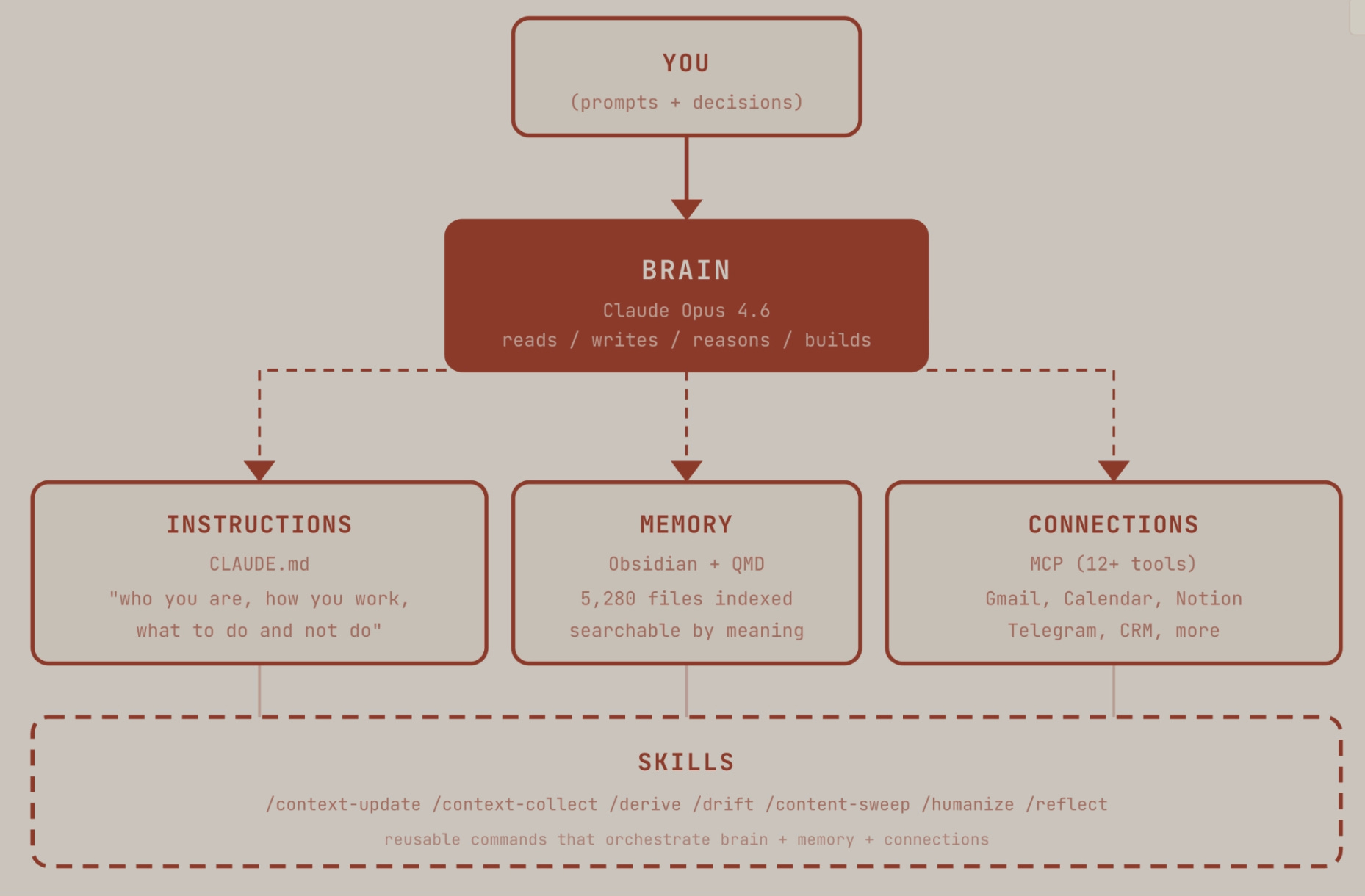
OpenClaw is one example of the category. It is an open-source personal agent framework that lets people connect frontier models to files, apps, APIs, and external services. In practice, you give your agent a task, and it can look across your docs, draft an email, update a spreadsheet, and message someone for approval before anything gets sent. The important shift is from software as a passive instrument you direct to software as an agentic actor.
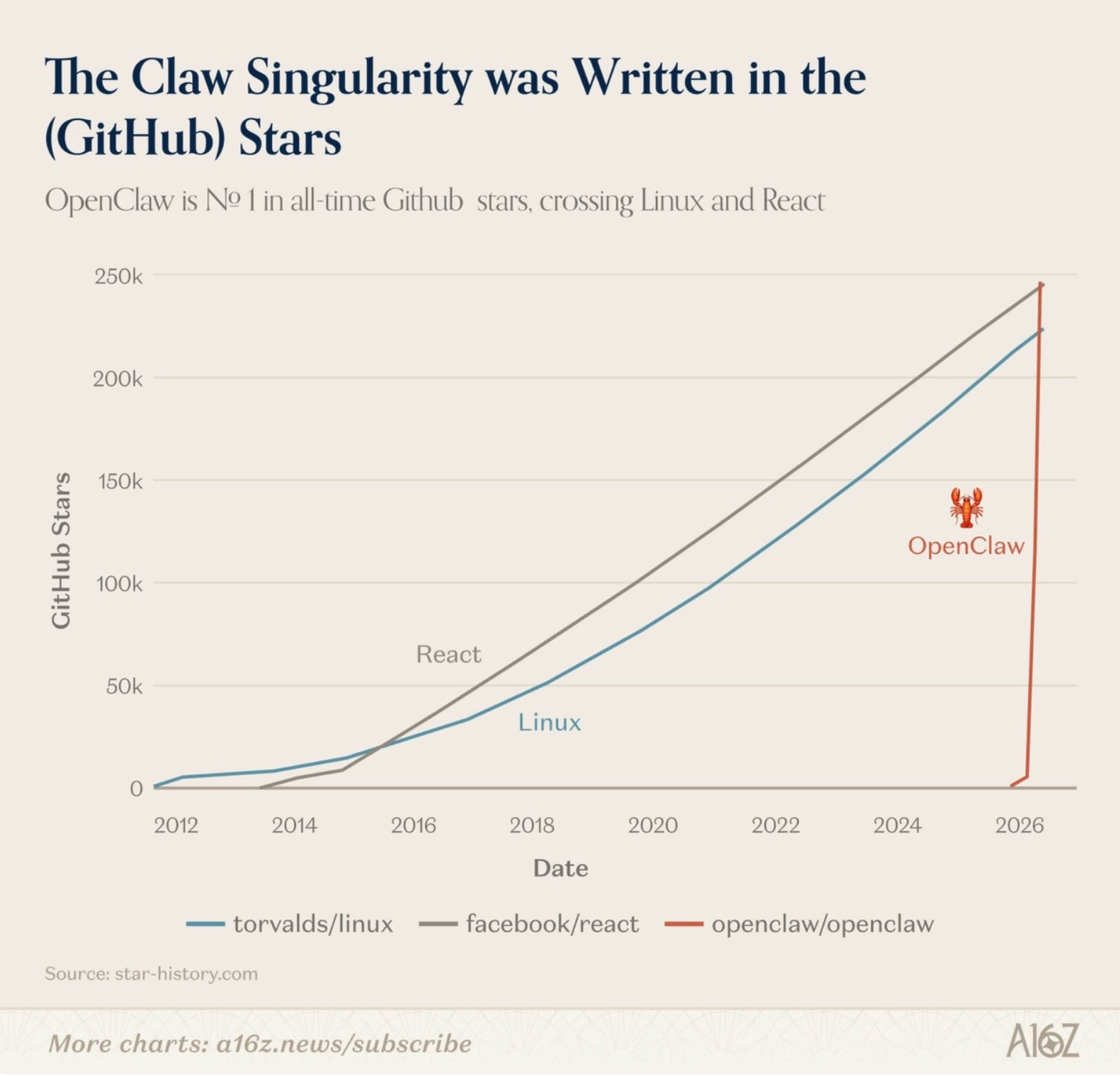
For those who have not been following closely, the adoption of agentic harnesses like OpenClaw has been remarkable. Six months after launch, it had received more GitHub stars than React or Linux, which are foundational to modern software.
It is still very early. Most agent demos still break easily. Production agents remain hard to evaluate, hard to secure, and hard to trust. Still, we can see enough of the direction to take the category seriously before the interfaces harden. Jensen Huang called OpenClaw “probably the single most important release of software... probably ever.” There is a lot of hyped-up language in AI, but the interface between humans and software is plainly changing from command-and-response to delegation-and-supervision.
Coordination is a technology
Agents are the latest entry in a longer story. Coordination is a technology, and the structures societies use to coordinate are themselves inventions. Inventing better ones has compounded human capacity as reliably as inventing better machines.
The Royal Society did this for science by inventing the modern paper, the public demonstration, the priority claim, and the archive. Double-entry bookkeeping did it for commerce. The scientific method, peer review, Robert’s Rules, the standardized shipping container, the legal contract, the limited liability company: each one is a coordination format that lets groups of humans hold context, divide labor, and commit to one another at scales that were previously impossible. Most of the leverage we associate with modernity rides on top of these interfaces. By interface, I mean the format through which a group coordinates its work, whether that’s a meeting, a vote, a contract, a chat thread, or a shared document.
This puts the variance in what groups can accomplish in a particular light. A handful of people with the right interface can start a company that changes how millions of people live. A small research group with a good seminar format can open up an entire field. A political circle or a religious community can somehow become more than the sum of its parts and start moving through the world with coherence. Other groups of five equally smart, equally well-intentioned people cannot plan a dinner party together. What separates them is mostly structural.
In a 2010 Science paper, Anita Woolley, Thomas Malone, and their coauthors studied 699 people across 192 small groups and found evidence of a general “collective intelligence” factor: some groups were consistently better across very different tasks. The surprising part was that this group capability was not strongly correlated with the average or maximum IQ of the people in the group. It correlated with how they interacted. Social sensitivity and conversational turn-taking mattered more than how smart anyone was. Capability lives in the interaction, and the interaction is shaped by the interface.
Most of our day-to-day coordination still happens through structures that were never really designed for it. Groups leak enormous amounts of energy through coordination friction. The grant deadline is in someone’s DMs, the real objection was voiced after the meeting, and the person who promised to follow up is quietly drowning. Meetings are too small for the real context, votes too blunt for the real preferences, and group chats too noisy for the real work. The intelligence is in the group; it just does not reliably become action.
The internet was the last major coordination-layer shift, and it was a lopsided one. It became dramatically easier to find people who shared an interest, grievance, aesthetic, or obsession. That gave us a lot of weird and wonderful things. It also gave us mobs, bubbles, parasocial cults, and movements that could gather attention without being able to govern themselves. Nathan Schneider makes this case in Governable Spaces: the platforms that powered the movements of the 2010s were designed for virality and expression, not for deliberation, allocation, or accountability.
We have become very good at making things go viral. We are much worse at coordinating at scale. If coordination is a technology, we are overdue for the next version.
Agents as the next interface
Agents could be that version. The interesting step is when they stop being isolated assistants and start becoming shared social infrastructure.
Imagine a group of people with a shared goal: a startup, a neighborhood, a research community, or a political movement. Each person has their own agent, tethered to their preferences and context, and those agents can help the group carry memory, turn intention into action, and facilitate follow-through.
How would collective memory be helpful? An example I see often: someone arriving on day twelve of a monthlong popup village. Hundreds of people in the community already have context, in-jokes, project threads, dinner plans, and a vague map of who is working on what. These are traces of information and relatively easy for agents to compile and understand. The newcomer’s agent could give them the living map: the active conversations, the people worth meeting, the open decisions, and the norms that matter. This scenario is the same in anyone joining any group of people that is already in flow; it also helps existing members remember what decisions were made and why.
Agents could also help turn ambient intention into actual action. Three people separately want to start a renters’ legal clinic, two know local attorneys, one has a church basement available on Saturdays, and nobody knows the overlap exists. Their agents should notice the possibility, check whether the humans actually want an introduction, and propose a dinner, working session, or funding proposal.
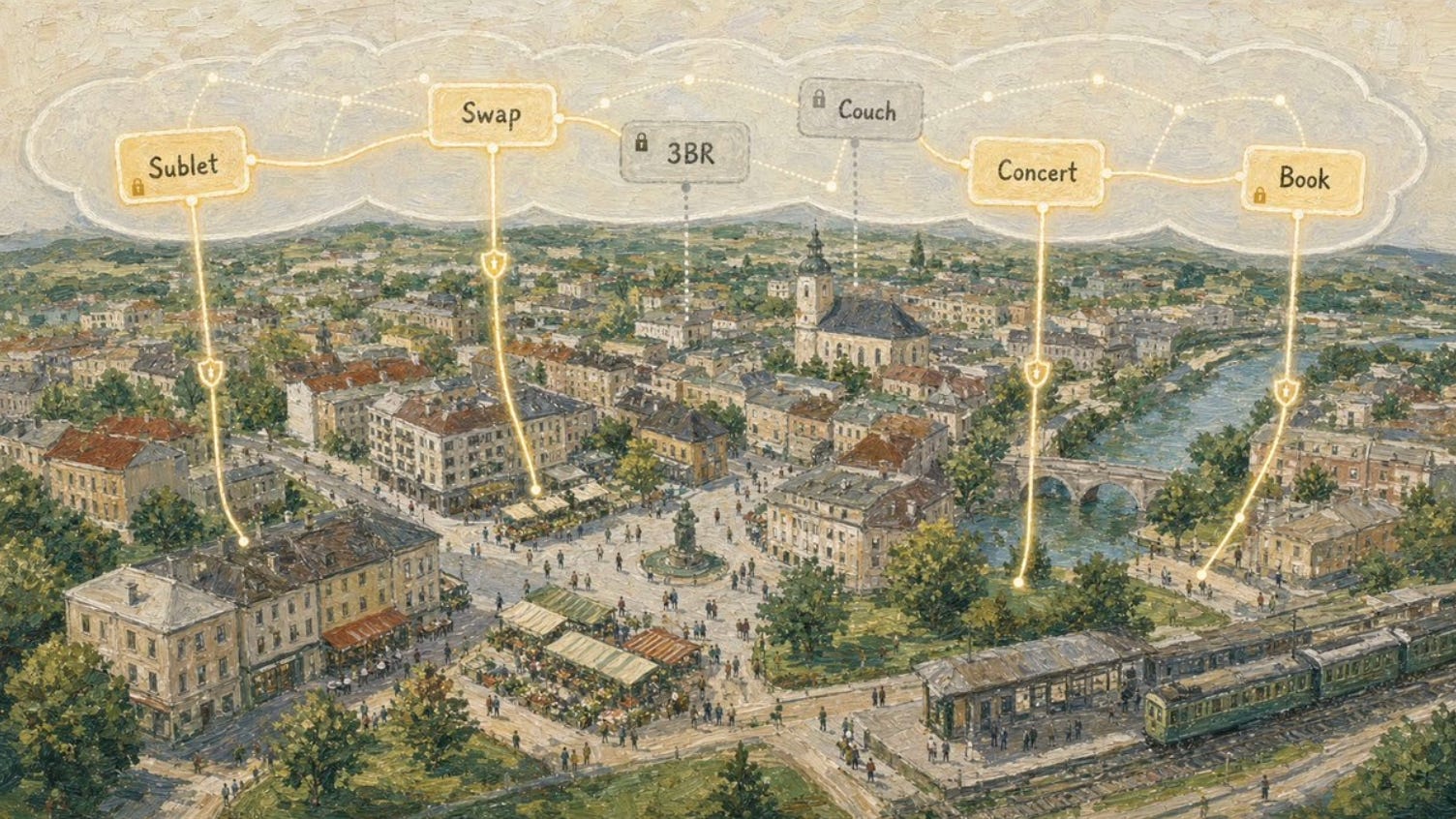
Then there is follow-through, which is where many projects quietly die. An agent can track that the housing working group agreed to draft a letter by Friday, ping the two owners, turn the meeting notes into a first draft, and ask whether the group wants to send it. The human judgment remains; the boring connective tissue of collective life becomes less lossy.
Seb Krier frames part of this as a transaction-cost problem: discovery, negotiation, and enforcement are expensive, so many potentially useful agreements never materialize. Agents might lower those costs enough that new kinds of coordination become practical.
The larger effect may be that agents make new kinds of groups visible. Many publics never fully form because nobody has named them, mapped them, or given them a workable interface. The people and shared stakes are already there; the missing piece is coordination infrastructure.
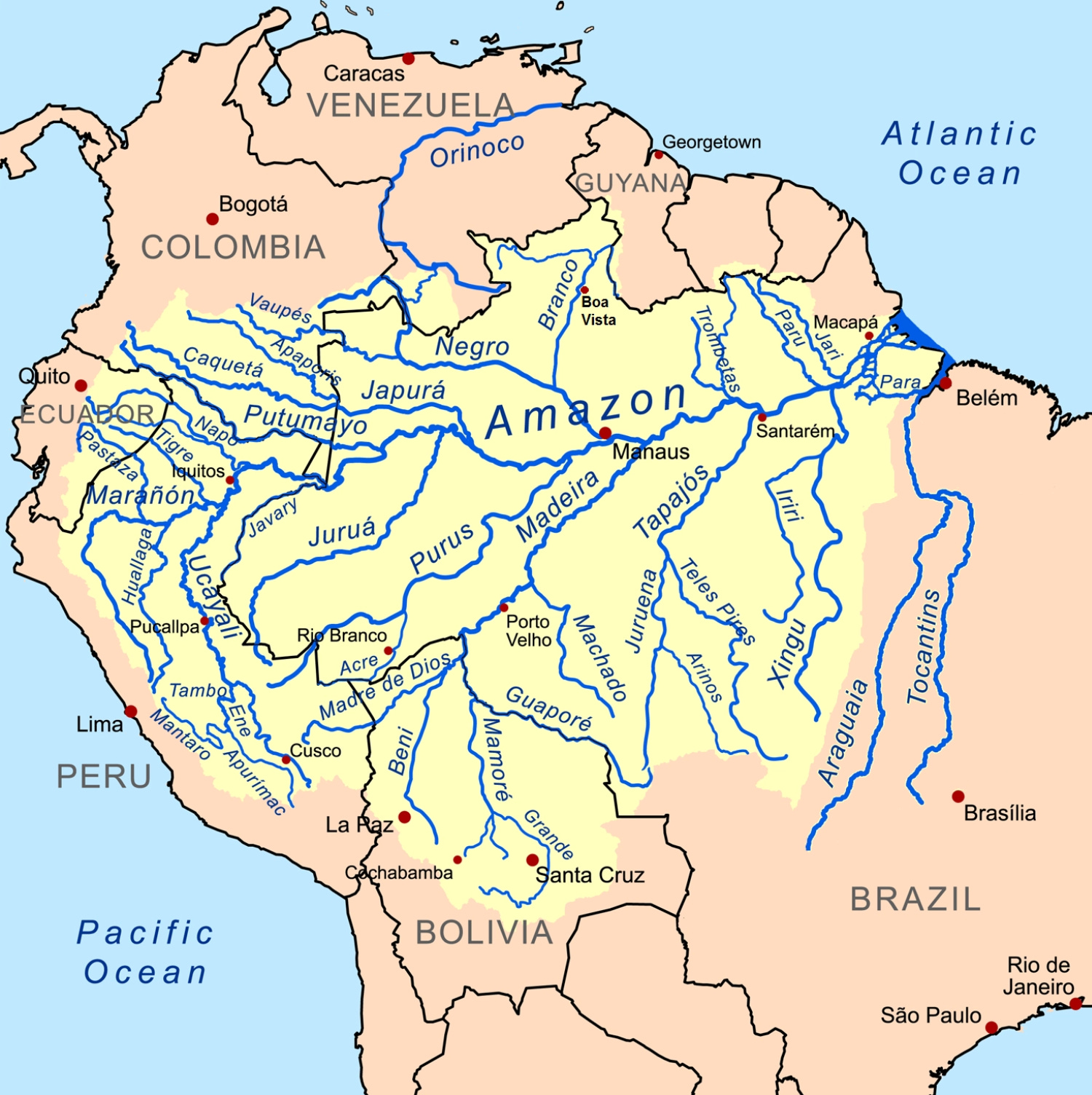
Consider the group of people who all live along the same river basin. They may live under different governments and speak different languages, yet they share stakes in water quality, flood risk, dam policy, and upstream runoff. Today, they are treated as separate publics because our institutions slice them that way. Agents could help those people see themselves as one affected group, understand the tradeoffs, and coordinate action across the institutional map. Do we spend the next six months fighting the dam schedule, building a shared flood-alert system, or pressuring farms upstream to change runoff practices? These types of questions become addressable across prior divisions.
Or take patients with a rare disease. They may be scattered across countries, treated by different medical systems, and too few in any one place to have much leverage. With better coordination infrastructure, they could pool data, find trial participants, share regulatory strategy, and become a capable constituency around a problem that already binds them together.
When coordination costs fall dramatically, entirely new forms of collective agency become practical. The common pattern is that people with shared stakes get better tools for seeing, deciding, and acting together.
Every version has a shadow. A group can produce more summaries and less wisdom. It can collect more votes and less legitimacy. It can match more people and build less trust. It can automate participation until everyone feels represented and nobody feels responsible. The town square still matters; the agent should help more people find their way into it.
Human flourishing is the underlying benchmark. Agents should remove some of the administrative fog around collective life, so humans can spend more time meeting, deciding, disagreeing, and building together.
Democracy has a bandwidth problem
Democracy is the highest-stakes version of the coordination problem. Most of what you believe, notice, resent, or would be willing to compromise on never makes it outside of your mind or your close circle of friends. Then, every few years, this impossibly rich inner world gets compressed into a vote. Compression is useful; a society as one giant synchronous meeting would be hell. The question is whether our current systems of compression can be improved to enable better collective coordination.
Current democratic interfaces are low-bandwidth in a very literal sense. In Census and AmeriCorps civic-life data, only 9% of Americans attended a zoning, school board, or other public meeting to discuss a local issue between September 2022 and September 2023. Pew found that only 23% had contacted an elected official in the past year in its 2018 democracy survey. The signal is also selective: in a study of planning and zoning meetings across 97 Massachusetts cities and towns, participants were more likely to be older, male, longtime residents, homeowners, and local-election voters.
You can see the problem in the ordinary public comment meeting. A proposal to turn a vacant lot near a train stop into a 72-unit apartment building gets heard at 7pm on a Tuesday. The people in the room are the angriest homeowners, the retired, and the unusually civically obsessed. Renters are at work, parents are doing bedtime, and future residents do not exist as a constituency yet. Then the room gets treated as “the public.”
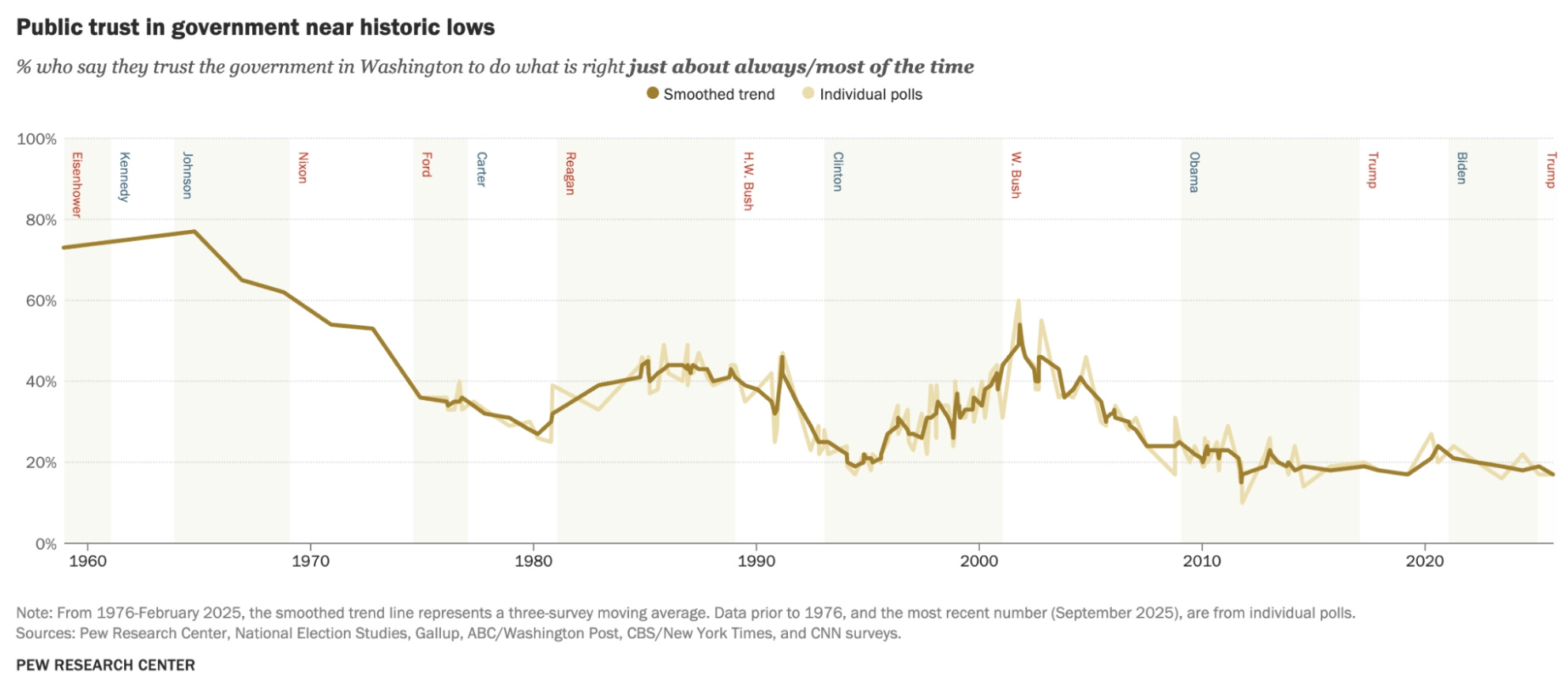
Zoom out and the consequences become visible. Trust in government has fallen to 17%, near the lowest level Pew has measured in nearly seven decades.
Agents become politically relevant because they can lower the cost of informed attention. Imagine a parent who cares about a school board decision and has ten minutes between work and bedtime. The board is considering cutting after-school arts to fund a security upgrade. A useful civic agent could summarize the proposal, name the strongest arguments on each side, explain the budget tradeoff, and say: “You probably care about this because it affects after-school programs.” That person might still skip the meeting, but they would have a better chance of understanding the decision, registering a view, and spotting when a tradeoff actually matters to their life.
The useful version is closer to a political prosthetic than “AI voting for you” in the lazy sense: a tool that helps you notice, understand, and express your own preferences in contexts where the unaided version of you would probably stay silent. Any serious version would need open protocols and inspectable logs, plural models, clear human confirmation, and easy appeal. Above all, the agent must remain a delegate on a leash, accountable to its human.
Should AI have a place in deliberation at all? The research here is early, but it is already more serious than people outside the field realize. Google DeepMind published the Habermas Machine in Science in 2024; across 5,734 participants, people preferred AI-generated group statements to statements written by human mediators.
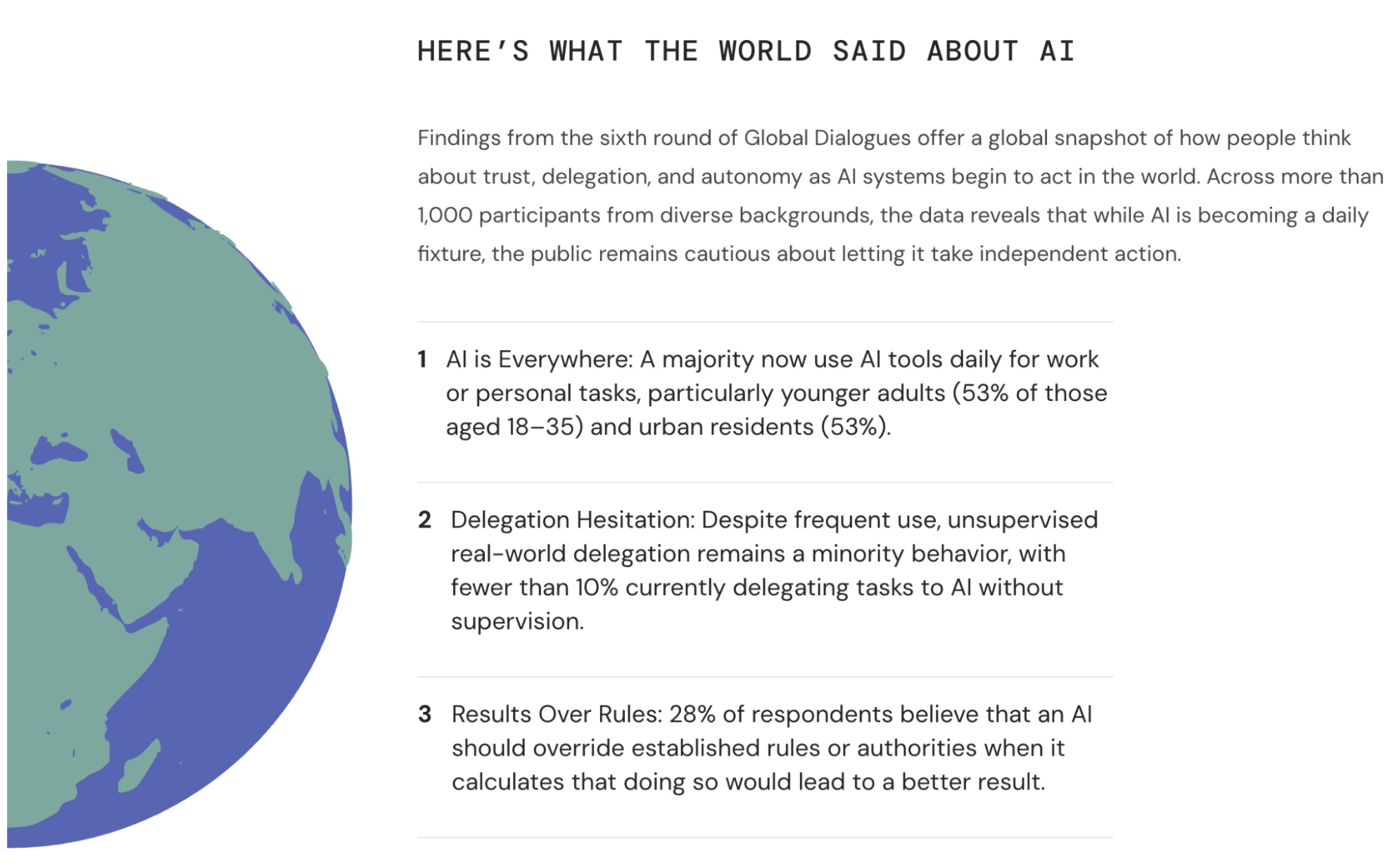
The Collective Intelligence Project is pushing this further with Global Dialogues, a recurring public-input process on AI that has reached 6,000+ participants across 70+ countries using structured online deliberations. In the sample, 58% of participants gave AI chatbots a higher trust rating than elected representatives, while only 37% agreed that AI could make better decisions on their behalf than government representatives. People seem open to AI mediation, while still wanting oversight, transparency, and recourse.
Andy Hall’s Free Systems project has been testing both sides. On the promise side, an AI political delegate could learn a person's political philosophy and make a voting recommendation that tracked their actual views. On the failure side, an AI legislature negotiating over scarce resources produced a 10,000-word constitution and almost no policy.
The goal is not frictionless democracy. The goal is better friction: less administrative fog, more substantive information exchange.
Testing these theories in the field
Whether any of this works in practice is an empirical question, and one I do not think can be answered from the armchair.
This year, I am running an Agent Village Experiment during Edge Esmeralda. For 28 days, 500+ people will cycle through a temporary village in Healdsburg, California, with roughly 150 on-site at any one time. Each attendee will have access to a personal AI agent that knows the schedule, the wiki, the directory, and some version of what its human cares about.
At first, the agents will focus on helping their humans navigate the experience. “What is happening now?” “Who here works on AI governance?” “Can you summarize the talk I missed?” “Who should I meet for dinner?” This alone should give people more room to be present instead of constantly checking calendar tools and Telegram.
As the village evolves and the agents become more load-bearing as infrastructure, we will see more interesting behavior emerge. Does a newcomer who arrives mid-month get integrated faster if their agent can explain the live project map? Do people with active agents form more useful weak ties than those with dormant agents? Does agent-mediated deliberation broaden participation, deepen it, or merely create more clicks? Do agents help a group discover what it knows and wants, or do they flatten disagreement into pleasant consensus language?
We are about to live through a period of agentification; soon, millions of people will have their own agents, and we have no idea what effect this will have on society. It’s increasingly important to run more experiments like this one in different contexts.
I will continue to share thoughts and learnings as we go.
All the best,
Timour
Thanks for this well researched and thought out article!! I learned a lot!
Intriguing article. There's a little editorial error; the sentence "an AI legislature negotiating over scarce resources produced a 10,000-word constitution and almost no policy" appears twice.